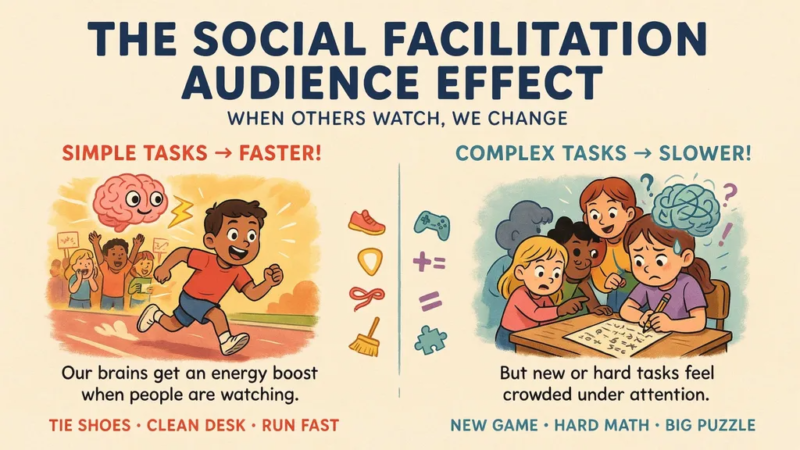
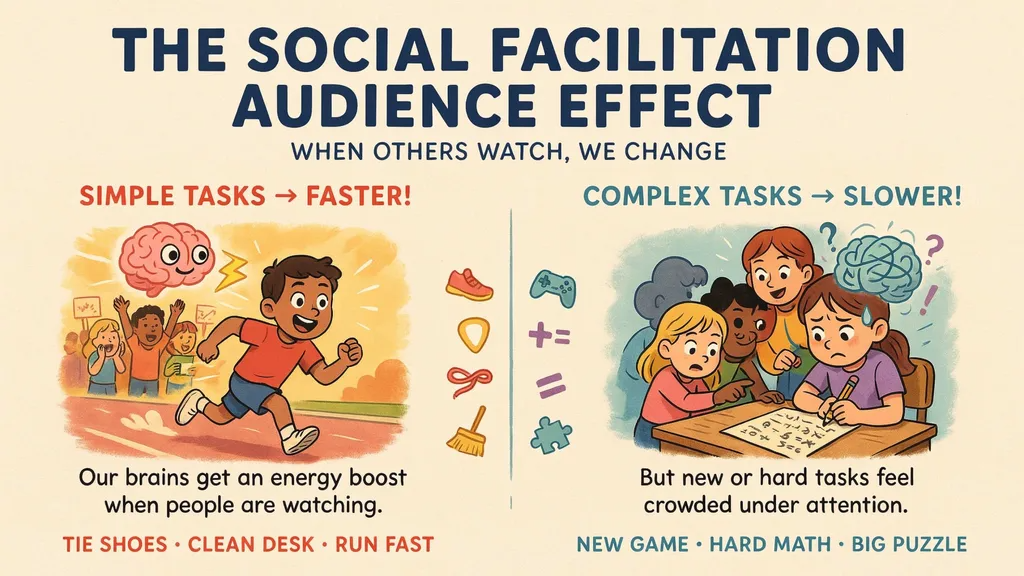
Have you ever noticed how you suddenly run faster when people are watching you? Or maybe you practice your guitar better when a friend is in the room. This is a very cool trick of the human brain called the Social Facilitation Audience Effect. It simply means that just having other people around us can change how well we do things. You might wonder why this happens to us. Long ago, having a group near us meant we had to stay alert. Today, that old wiring still lives inside our heads.
When an audience watches us, our bodies get a little boost of energy. This rush helps us do simple tasks much faster and better. Think about tying your shoes or cleaning your desk. When someone is looking, you might zoom right through it. But this does not work the same way for every single task. If you are learning a brand-new video game or trying to solve a hard math puzzle, an audience might actually slow you down. The extra attention makes your brain feel a bit crowded. Knowing this balance helps you understand your own work habits every single day.
The History of Social Facilitation Studies
Long ago, scientists became very curious about how groups change our actions. A smart man named Norman Triplett noticed something fun while watching bicycle riders. He saw that riders went much faster when they raced against other people instead of riding alone against the clock. He wanted to test this idea in a safe space. So, he asked kids to turn a little fishing reel as fast as they could. Some kids did it alone, and some did it next to a partner.
The kids who worked next to a partner turned the reel much faster. This was the very first test of the social facilitation audience effect in a science lab. After that day, many other researchers wanted to test the same thing. They tried it with ants, birds, and lots of human volunteers. Every time, they found that just sharing space with others changed the speed of the work. It proved that our minds act differently when we share a room. This big discovery opened the door to modern social psychology.
Why Other People Change Our Energy
Have you ever wondered why your heart beats faster when you step on a stage? That is physical arousal at work. When people look at us, our nervous system wakes up. It gets us ready for action, whether we want it to or not. This extra alertness makes our bodies release natural energy chemicals. Because of this, the social facilitation audience effect kicks in and gives us a sudden push. We feel more awake and more focused on the exact moment we are in.
Think of it like stepping onto a bright sports field. The lights are on, and the fans are cheering. You feel alive and ready to move. This exact rush is super helpful for things you already know how to do well. Your body knows the steps, and the extra energy helps you shine. But if you are nervous, that same rush can feel a bit scary. Understanding this energy boost helps you stay calm when all eyes turn directly toward you in class or at work.
Simple Tasks Versus Hard Puzzles
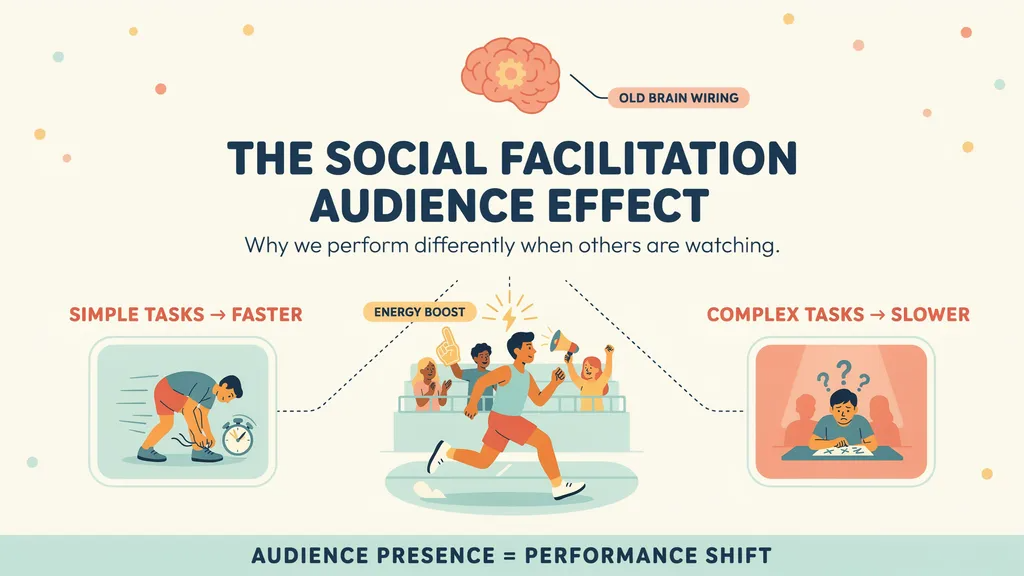
Not all tasks are the exact same in our daily lives. Some things are super easy because we have done them a million times. Other things are really hard because we are still learning them. This difference changes how the social facilitation audience effect treats us. For easy jobs, an audience is your best friend. It gives you the boost you need to finish your homework or clean your room in record time.
However, for hard puzzles, an audience can feel like a heavy weight. Imagine trying to tie your shoes while three people stare at your fingers. It suddenly feels clumsy, right? When we learn a brand-new skill, our brains need quiet space and time to think. Too many watchers create pressure. Knowing this trick means you can choose when to practice alone and when to show off your skills to friends. It is all about finding the right balance for your current project.
Real Life Examples You See Every Day
You can spot the social facilitation audience effect happening all around you without even trying. Think about playing a sport in gym class. When the teacher or your friends watch you shoot a basketball, you might try a little harder to make the shot. Or think about cooking a simple meal. If someone stands in the kitchen chatting with you, you might chop your vegetables much quicker. These small daily moments prove that our social brains love company.
Another great example happens right in school. Have you ever noticed how reading out loud to yourself is easy, but reading to the whole class feels nerve-wracking? That is because the audience changes your focus. Musicians feel this too when they play their favorite songs for a family member. The presence of a friendly watcher turns a normal task into an exciting moment. Next time you notice yourself speeding up around others, you will know exactly why your brain acts that way.
How Social Pressure Shapes Our Focus
Focus is a funny thing. Sometimes we can stare at a book for hours, and other times a tiny noise distracts us. When people watch us, our focus narrows down. We start paying extra attention to what we are doing and how others see us. This intense focus is a major part of the social facilitation audience effect. It stops our minds from wandering off to other thoughts because we know eyes are on us.
This tight focus is wonderful for physical actions where you just need to push through. But it can make thinking jobs a bit tricky. If you need to be creative and imagine a new story, too much pressure can block your bright ideas. Our brains need a little room to wander when we dream up big projects. By keeping track of how pressure changes your focus, you can pick the best spots for your daily study time.
The Role of Competition and Shared Spaces
Humans are social creatures who love to connect, and we also love a little friendly race. Sometimes, an audience is not just watching; they are doing the exact same thing right next to you. This is called co-action. It adds a fun layer to the social facilitation audience effect. When you see someone else running down the track, you naturally want to match their speed. It pushes you past your normal limits without you even realizing it.
Shared spaces like skate parks, libraries, and art studios use this idea every single day. When you sit in a room where everyone is reading quietly, you feel inspired to read too. The group energy pulls you right into the task. It is like an invisible team spirit that helps everyone get things done. Building a nice shared space with your peers is a fantastic way to boost your daily focus and finish your goals together.
Why Online Audiences Feel Different Today
The world has changed a lot, and audiences are not just sitting in the same room anymore. Today, people stream video games, post pictures, and share homework online for thousands of people to see. This brings up a brand-new side of the social facilitation audience effect. Even though a screen separates you from the viewers, your brain still knows people are watching. That flutter in your chest is very real, even through a digital camera.
When you record a video or jump on a live call, your body reacts just like it would on a real stage. You want to do your best because you know others are tuning in. This modern twist shows that our old human instincts work everywhere, even inside computer pixels. Understanding digital audiences helps us feel more relaxed when we share our cool creations with the wide online world.
Tips to Use This Effect to Your Advantage
You can use the social facilitation audience effect as a superpower to help you succeed in school and play. If you have a boring chore that you always put off, try inviting a friend over to hang out while you do it. Their gentle presence can give you the push you need to finish fast. It turns a dull afternoon into a fun team moment where everything gets cleaned up in no time.
On the flip side, if you are studying hard math or writing a brand-new story, find a quiet corner all to yourself. Give your brain the peace it needs to solve hard problems without any extra pressure. By matching the right task to the right environment, you take full control of your daily energy. You become the boss of your own focus, ready to tackle any goal that comes your way.’
Frequently Asked Questions
What is the social facilitation audience effect in simple words?
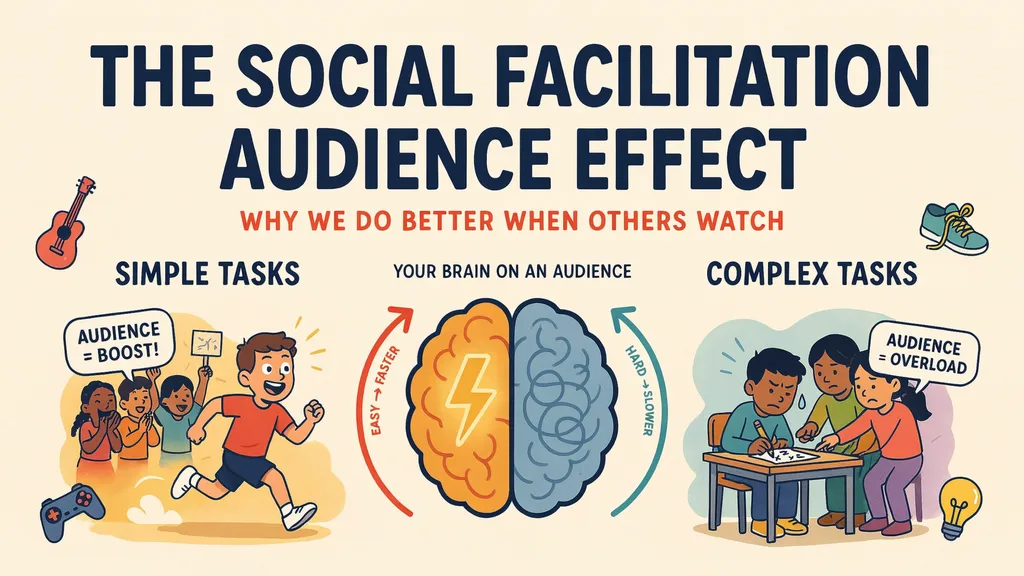
It is a natural brain reaction where having other people around makes you do easy tasks faster and better.
Why do people work faster when someone is watching?
An audience wakes up our nervous system and gives our bodies a nice rush of physical energy.
Does this effect help with hard tasks too?
No, hard or new tasks can feel much harder when people watch because the extra pressure creates stress.
Can online viewers cause this same feeling?
Yes, streaming videos or sharing posts online makes our brains feel the exact same audience pressure.
How can I use this effect to clean my room faster?
You can invite a friend to sit with you or chat while you work to get that extra burst of helpful energy.
Is this effect good for learning new skills?
It is usually better to practice brand-new skills alone in a quiet space until you feel totally confident.
Conclusion
Understanding the social facilitation audience effect unlocks a super fun secret about how our minds work every day. Whether you are running a race, finishing your homework, or sharing your art online, other people shape your energy in amazing ways. Now that you know how this balance works, you can pick the best spots for studying and the best times to shine with friends. Why not try studying alone for a hard test today, and then invite a buddy over for your next fun chore? Share your thoughts or your favorite focus trick in the comments below!